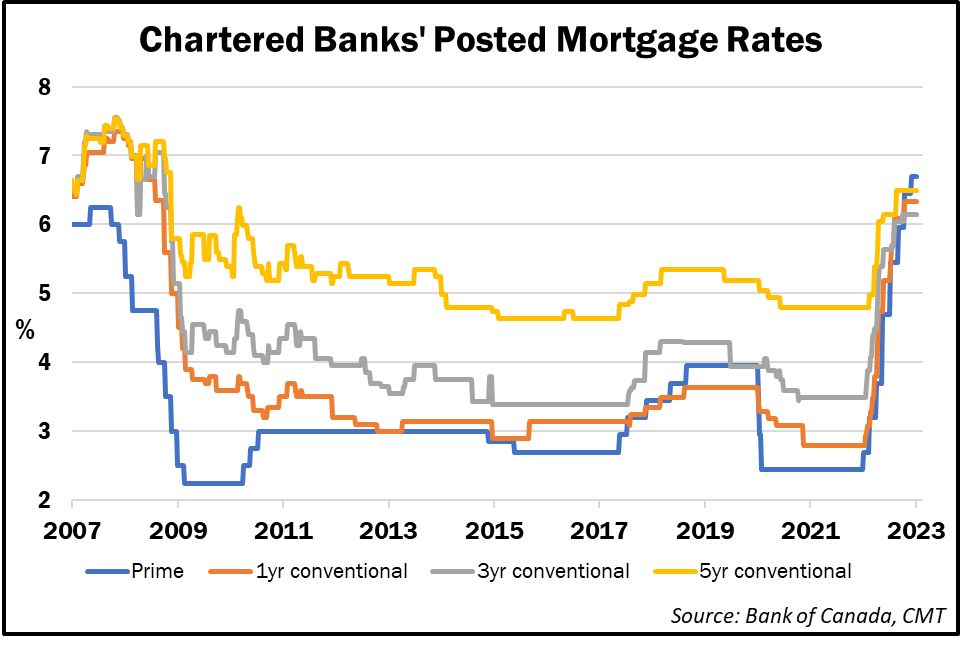
MORTGAGE INTEREST RATES IN CANADA

What is happening in the world of borrowing monies for your mortgage in Canada with the skyrocketing interest rates?


The decisions Canadians make on their mortgage in 2023 are in large part dependent on the mortgage rate forecast. It’s a decision that will affect homeowners for several years to come and could lead to thousands of dollars in mortgage interest savings. 

Here we will look at where mortgage rates are likely headed, based on a current January 1, 2023 review of economics, years of in-depth mortgage market study, and working with thousands of mortgage files. 

These 4 main predictions will be reviewed (fully updated for Winter – Spring 2023):

  1. Historical context: Mortgage rates are forecasted to increase further in 2023, but rates are likely to gravitate lower over the long term to a historical trend in the low-mid 3% range.

  2. The market consensus on the mortgage rate forecast in Canada (as of January 1, 2023), is for the Central Bank to increase mortgage interest rates by another 0.25%, to a 4.50% high in early 2023,  and may go higher if inflation is not on track to drop less than 4.50%.

  3. Early signs of economic slowdown and lower mortgage rates.

  4. How to reduce your risk against mortgage interest rate increases, best position yourself in this rate cycle, and save the most on your mortgage.


Historical context: Mortgage rates in Canada are forecasted to gravitate towards historical lows for the long term of 5 – 10 years.

To help determine mortgage rate forecast, one of the best perspectives we have available is a historical one.

During the great recession of 2008, the financial system and economy as a whole required bailouts and stimulus as never before seen, just to keep running. Thankfully, the stimulus did its job, and the economy rebounded and got back on track. However, between 2008 and 2019, for over 10 years, there was very low or stagnant GDP growth, and interest rates remained low accordingly. 

Now in an era of COVID, in 2020 – 2023 we witnessed a similar massive economic bailout. The difference this time is the stimulus was far greater, with over 40% of dollars ever created between 2020 – 2022. 

However, in part due to a literal shutdown of the economy and of supply chains at one point, and difficulty rebooting these supply chains, along with the unfortunate war in Ukraine and supply issues in the housing market, there is much more inflation as the economy stabilizes.

This inflationary difference will be discussed in more detail just below. However, the main point here is that historically, when there is a massive new government and private debt layered upon already massive debt, this can perpetuate dependence on yet ever cheaper debt to stimulate the economy. It can lead to long-term economic stagnation and, importantly, to a ‘magnifying effect’ of increased rates. 

More specifically, with 5 times more debt in the economy today, adjusted to inflation, than in the 1980s and early 90s, a single 0.25% rate increase makes a 5 times bigger impact than it did when debt levels were a fraction of current levels. Accordingly, there is significant long-term pressure for rates to remain low. 

From another historical perspective, when rates increased in the 1980s from a base point of 10% to a 20% high point, this represented a 2x rate increase. However, a rate increase in 2022 – 2023 from a base point of 0.25% to 4.50% represents a 16x rate increase, which will have a much greater shock to the economy.


*If you'd like to be put in contact with one of our preferred mortgage broker specialists, please reach out to me.*


As of January 2023, the market consensus on the mortgage rate forecast in Canada is for the Central Bank to increase mortgage interest rates by another 0.25% in 2023 from 4.25% to a high of 4.50%.

We will likely see this prime rate increase when the Central Bank meets on January 25, 2023. There is some early speculation that there could be an additional 0.25% increase on March 8, 2023, however, it is too early to forecast this second 2023 rate increase.

The main tool we have when reading the current mortgage rate market is the Government of Canada Bond Yield. The Canadian bond is a government debt security that pays a return to an investor. The ‘%’ based return is called the ‘yield’ and it is considered to be one of the safest investments because the Government would have to go bankrupt, in order for it not to pay its investors. 

The Government of Canada's 5-year Bond Yield factors in all known economic data on a day-to-day, and even a minute-to-minute basis. Simply put – when the market/ bond traders think that the Central Bank of Canada will increase rates, the Bond Yield increases. When the Bond market thinks the Central Bank rate will decrease, then the yield drops. In other words, the Bond yield trades, or is priced in anticipation of where the Central Bank of Canada rates will move. The Central Bank of Canada makes its rate decisions, based on the status of the economy. 

Currently, as seen in the Yield chart below, the Canadian Bonds are priced in anticipation of a further 0.25% increase in Central Bank of Canada rates in early 2023 or perhaps slightly higher.

A slowing economy, lower inflation and lower Bond Yields. What does this mean for mortgage interest rates?

With lower spending comes a slowing economy and lower inflation, and eventually, lower mortgage interest rates.

Current high rates will lead to lower rates – by design.

As of January 2023, there is a growing consensus among big banks that a recession in Canada will happen in 2023. The big banks have a unique real-time view of massive amounts of cardholder spending data and are well-positioned to report on economic trends sooner. In summary, what we are hearing is that spending is decreasing significantly due to higher costs throughout the economy and higher interest rate expenses, to the point of an overall economic slowdown.

As consumer demand drops, prices of many economic inputs such as oil, copper, steel, silver, lumber, microchips, shipping costs and many other commodities have fallen drastically. These trends are very anti-inflationary. However, housing costs (ie. rents), food costs and travel/leisure activity continue to be strongly inflationary. Likely there will be a point in 2023 when these more inflationary areas of the economy cool off.

It is known in economics and recently mentioned by the Central Bank of Canada, that it takes approximately 1 year for a single interest rate hike to ‘trickle through’ or have a full effect on slowing an economy. While the first small 0.25% interest rate hike in Canada happened in March 2022, as of January 2023, we have really only seen about 9 months of effects of the more significant ‘super-sized’ rate hikes, let alone the effects of a full year of multiple rate increases. So it is important to keep in perspective that:

(1) The previous rate hikes we have seen have not had their full effect on slowing the economy, and we are already seeing a recession on the near-term horizon.

(2) The markets are expecting another 0.25% of a rate increase before stopping.

Accordingly, the narrative is also shifting away from the likelihood of a ‘soft recession’  in 2023 towards a harder-felt recession. At the point of a more severe recession, inflation is likely to be reduced significantly.

So what does this mean for mortgage rates?

What goes up to slow the economy, will eventually come down to stimulate the economy.

The Central Bank of Canada (and the Federal Reserve in the USA) is determined to fight inflation, which is why they are seen as slamming the breaks on the economy as a whole. There is no doubt this, unfortunately, will be painful for many. However, low inflation is needed on a foundational level to enjoy another long-term run of low interest rates.

Eventually, the Central Banks will begin lowering rates again to stimulate the economy and pull us out of the recession. This means lower mortgage interest rates.

More specifically, once the Central Bank reaches its peak rate or ‘terminal rate’, historically, it takes on average 6 months for the Central Bank to start lowering rates again.

In 2023, Bond markets are currently projecting the first Central Bank rate drop in November. This would mean a full 10 months at the peak rate – longer than the 6-month peak rate average.

However, to take a more careful and conservative projection, it could be January 2024 before the first Bank of Canada rate drop.

So given current market conditions, a good reference point would be between November 2023 and January 2024 for the first-rate drop.

However, if the economy slows harder and faster than expected, we could see the Central Bank lower rates sooner in 2023. 

While the variable rate mortgage is directly affected by the Central Bank decisions, we will likely see 3-5-year fixed rates generally float lower throughout 2023. Because fixed rates are ‘pegged’ to the Government of Canada Bond Yields and Bond Yields trade in anticipation of Central Bank rate decisions, we will see fixed rates move lower much sooner.

Rates will not normalize at the lowest levels seen during COVID-19. However, as fixed mortgage rates approach a highly restrictive 5.5 – 6% range, the expectation is that rate normalization may occur into the low to mid ‘neutral rate’ range, or in the low 3% range for mortgage rates.

The CIBC Capital Markets projection from April 2022, seen just below, illustrates a good representation of this forecasted rate trend. However given stubborn inflation, the Central Bank rate peak will clearly be higher than in the numbers indicated in the chart:

Again, while the exact numbers are not coming in as was expected in April 2022, the main thing to note from the chart is that the rates and bond yields are increasing into 2023, but then towards the end of 2023 and into 2024, the bond yields are forecasted to drop, prompting a decrease in the Central Bank of Canada rate. This bigger-picture rate trend is the primary idea behind the chart. 

How to reduce your risk against mortgage interest rate increases and save the most on your mortgage.

At this time of higher rates, unfortunately, there is no good low rate to lock into. With this said, a calculated approach may be considered to position yourself to take advantage of lower rates once they begin to fall.

According to the Central Bank, it could take until late 2023 and into 2024 for inflation to fall substantially and for their prime rates to drop.

A Fixed Mortgage Rate Strategy to Reduce Interest Rate Risk

The traditional thinking is that a 5-year rate is a safer bet. However, from the ‘rate drop’ perspective analyzed, if you lock in a higher rate for too long,  there is a risk of paying too much. 

Therefore a shorter term, 3-year fixed rate, for example, could position you better to renew into a lower fixed rate in 3 years’ time. For example, if your rate today is locked in at 4.59%, you would not see further upside on your rate for the next 3 years. This zero upside potential comes with the peace of mind many Canadians are looking for with their rate.

With this said, it is likely that rates will be down, perhaps 1% or even more in 3 years time, in 2026. So on your renewal date, at the end of the 3-year term, you would be better positioned to renew at a lower rate and potentially save thousands of dollars, versus remaining locked into a higher 5-year fixed term, for another 2 years.

A Variable Rate Strategy to Reduce Interest Rate Risk

For those with a higher tolerance for risk, a variable rate is worth considering because the savings could be substantial.

As we near the end of the most stunning rate increase cycles in history, the variable rate should stabilize. Then, as soon as the rate begins to fall, perhaps in late 2023 or early 2024, the variable rate holder will benefit immediately. This ‘lower rate sooner’ potential could lead to more savings than locking in even a shorter-term fixed rate.

Given over 40 years of historical rate data, as seen in a York University study on Canadian interest rates, the variable rate is likely to lead to more significant savings over the medium–long term.

There is certainly the potential for substantially more savings in the variable, but with higher variable rates currently and another 0.25% increase projected in January, it will take a thicker skin in 2023 to realize these savings over the next 1-3 years


Read

REAL ESTATE PROHIBITION ACT 2023

The Prohibition on the Purchase of Residential Property by Non-Canadians Act

prevents non-Canadians from buying residential property in Canada for 2 years starting on January 1, 2023.

The Government of Canada has passed a new law to help make homes more affordable for people living in Canada. The Prohibition on the Purchase of Residential Property by Non-Canadians Act prevents non-Canadians and corporations controlled by non-Canadians from purchasing residential property in Canada for 2 years, Ensuring the housing market remains available to Canadians

In developing the accompanying regulations, the Government reached out to Canadians for their feedback. A detailed consultation document containing specific policy proposals intended for the regulations was available for comment for 4 weeks in August and September 2022. The consultation process received approximately 200 written submissions from individuals and stakeholders.

The Regulations will also come into force on January 1, 2023. The Act and its regulations will be repealed after 2 years.

For more details, read the Regulations in the Canada Gazette.

Key Highlights

  • The Prohibition on the Purchase of Residential Property by Non-Canadians Act prevents non-Canadians from buying residential property in Canada for 2 years starting on January 1, 2023.

  • The Act defines residential property as buildings with 3 homes or fewer, as well as parts of buildings like semi-detached houses or condominium units. The law does not prohibit the purchase of larger buildings with multiple units.

  • The Act has a $10,000 fine for any non-Canadian or anyone who knowingly assists a non-Canadian and is convicted of violating the Act. If a court finds that a non-Canadian has done this, they may order the sale of the house.

  • Please note: This does not apply to non-Canadians who are looking to rent.

Disclaimer

The information contained on this site is for general guidance only and is not to be construed as legal or other professional advice. It should not be used as a substitute for consultation with legal or other competent advisers. Before making any decision or taking any action, you should consult a professional.

CMHC is not responsible for any errors or omissions in connection with the use of this information. All information on this site is provided "as is," with no guarantee of completeness or accuracy. 

CMHC won’t be liable to you or anyone else for any decision made or action taken in reliance on the information on this Site.


Read

INSURANCE COMPANIES DENY COVERAGE

Older Calgary homes are being denied coverage by most (if not all) insurance companies.

Many buyers are not aware that they will be denied insurance coverage on their purchase if one or more of these items are found in the home. Therefore, your mortgage company will not fund your mortgage until these deficiencies are rectified. One of the major issues is electrical.

ELECTRICAL:

60 AMP PANEL

If your Calgary home purchase has one or more of the following, you will not be insurable. 60 AMP service panels have to be upgraded to a minimum of 100 AMP panels. Many of the newer Calgary homes are installing 200 AMP service panels due to today's demand for all the new electronics in the homes. Be aware as well, that when you upgrade the panel, you also have to upgrade the feed from the street to your home and the drop into your meter. This can be several thousands of dollars cost.

ALUMINUM WIRING:

Burnt Receptacle

If your new Calgary home purchase has aluminum wiring in it, you will also be denied bound coverage. Aluminum wiring was installed starting in the 1960s but was outlawed in Canada in the late 1970s because it contracts and expands more than copper wiring, which leads to loose connections, arcing, and ultimately fire.

COPPER WIRING:

Copper wiring has been used since the banning of aluminum. Some copper may "appear" to be aluminum but is only coated in nickel for specific applications. It increases copper's resistance to corrosion and enhances its strength. Calgary homes after the late 1970s have copper wiring but some still "may" have 60 AMP service panels, which will have to be upgraded to a minimum of 100 AMP.

KNOB & TUBING:

Here we are taking a step back in time. Calgary home insurance companies do not like this era. Knob & tube wiring was predominant from the early 1900s up to the late 1950s. This is a very dangerous type of wiring to have in a home as it has no grounding and all connections are in the open. This makes your home very prone to catching fire when the wiring shorts out. Unlike today's copper wire connections that must be in an accessible, sealed junction box.

PLUMBING:


Poly B is the water line that you most likely have in your Calgary home if it was built between the mid-1970s to 1998. If your home was built prior to 1975 it will not have Poly B. However, we have found some homes relocated onto new foundations that have been extensively upgraded and classified as "newer" homes still have some Poly B. This pipe is prone to a short life and may decay at connections and or just spring a leak. The government of Canada officially banned Poly B™™ in 2005. 

Upon the banning of Poly B in Calgary homes, insurance companies are looking for either older copper lines and/or the Pex lines that replaced Poly B. Pex is a plastic type of line that is easily installed with either crimp rings or shark bite fittings. It is estimated that approximately 148,000 homes in Alberta had Poly B installed in them. Ultimately, one way of usually detecting if the home has Poly B is to go to the utility room and look towards the ceiling. If you see light to mid-grey plastic piping, it probably is Poly B. It will most likely be stamped on it as well. Another area to inspect is under the sinks to see what is connected to the faucets.

In summary, I would caution all buyers to enlist the services of a "qualified" home inspector as part of your conditions on the Offer to Purchase. Upon request, I usually refer to Cliff Keveryga as one of Calgary's most qualified inspectors. I feel very confident that my 40 (+) years in and around the trades are a great comfort and asset to my clients when we are previewing properties. My background has consistently saved unnecessary headaches and frustration for my buyers as we are able to quickly eliminate these homes as an option.

Read

Turn Your Home Into A Short Term Rental

How to turn your home into a short-term rental property

In these tough times, people are looking at new & different approaches to get through them. This is one temporary fix that may work for some. As the number of properties listed through short-term rental services like Airbnb and VRBO continues to grow, it’s natural for homeowners to wonder if they, too, can extract additional value from their homes. Have an extra bedroom, guesthouse or vacation property that sits vacant most of the time? Want to rent out your condo a few weekends a year to make a bit of extra cash? No matter your specific circumstances, here are some important dos and don’ts.

Do…

Understand the time commitment


This includes answering questions for potential guests, perfecting your listing, outfitting your property for guests, helping your guests check in and out, and troubleshooting for them during their stay.

Consider your neighbours


Whether you’re living in a downtown condo building or a quiet, suburban area, your neighbours can kill your listing if you’re not careful. Be considerate when it comes to points of contention like noise and parking, set clear house rules for your listing, and be selective about the types of guests you target and to whom you ultimately rent.

Determine your target guest


Make sure your listing appeals to the type of guests most likely to book with you, and least likely to cause headaches for you and your neighbours – business travellers in downtown areas, for example.

Have the right amenities


Make sure you have the essentials – including things like smoke alarms and CO detectors, a working TV with streaming capabilities, reliable Wi-Fi, and coffee – as well as amenities that will set your listing apart from the competition.

Set clear house rules


These should not be overly restrictive, but make sure you indicate what is not allowed. Things to address include smoking, off-limit areas, quiet hours, extra guests and pets.

Don’t…

Run out of toilet paper, napkins or paper towel
This is one of the easiest ways to ruin a guest’s experience and ensure a negative review for your listing.

Get the wrong insurance


Airbnb offers free host protection insurance of up to USD 1 million, but certain things – such as property damage from pollution or mould, and intentional damage or injury – are not covered under the policy. Talk to your home insurance company about options for additional coverage.

Have no spare key(s) available


People lose things, including keys, so make sure you’re ready with a backup plan. Lockboxes that guests can access that contain a spare key will go a long way towards improving your guests’ experience and making your life easier.

Drop in unannounced


People appreciate their privacy, so barging in on a guest is sure to sour their experience. Try to avoid visiting your listing during a booking unless there is an emergency.

Forget to provide towels
Just like any hotel room, clean bath towels and washcloths are a must to keep your guests happy.

Price your rental incorrectly


This requires regular monitoring and updating, as market conditions are constantly changing. Too high could mean extra vacant days, but too low could mean you’re not maximizing your earning potential. Third-party pricing companies, such as Wheelhouse, are also available for a small fee for hosts who want to eliminate most of the guesswork.

Read

Lawyers protect you in real estate deals

A well-chosen real estate lawyer

What do you know about Calgary real estate attorney fees?

Definitely, before committing to a lawyer as with any professional, you want to know how much they will charge for their services and do they have the required experience/knowledge. Only then you can make the crucial decision about whether or not this real estate lawyer is a good match for you. Here are a few tips for you about the disposition of real estate attorneys and their rates.

As a rule, lawyers in the real estate field charge flat rate fees for:

  • Real estate purchases

  • Real estate sales

  • Land transfers

  • Refinances

  • Mortgages

Before you enter into an agreement with your real estate lawyer, make sure you know what their fees include. The full complex of services involves the following, and occasionally more: 1st – all regular disbursements; 2nd – file administration costs; 3rd – document fees; 4th – photocopies; 5th – fax; 6th – courier charges; 7th – land title fees to register title and mortgage; 8th – approximately 2 hours of consultation to help you resolve various issues related to your sale or purchase; You should also keep in mind that there may be some additional fees for out of town services.

It is always better to discuss such issues with your real estate lawyer beforehand. This way you will avoid uncomfortable situations, and unexpected costs and will know in advance exactly what you are paying for. Occasionally, specialized services may not be included in the standard price so it is always a good idea to double-check everything.

Paying less is not always an option in real estate

It is perfectly understandable that everyone wants to save money at any cost. People, contrary to all logical rules, start searching for excellent quality services with great discounts. Sometimes they get lucky, but usually, it doesn’t work that way. For small fees, you usually get the equivalent service. There are many cases where clients were over-charged for the initial quote. This is because the real estate lawyers were not qualified in the real estate field. Some purported real-estate lawyers have even prepared fraudulent documents, and at the end of the day, the client ended up with significant ramifications.

To be on the safe side and avoid such misfortunes, do not get fooled by cheap service fees. Check everything carefully and only then, make your choice. Many times the cheap way out ends up costing you double and more.

What will my lawyer do for me?

Real estate transactions can be quite stressful. For that reason, your real estate solicitor should be a seasoned real estate professional and be qualified to represent your best interests. When handling your residential or commercial transaction, he/she should;

  1. Take control of and draft all documentation

  2. Represent your best interests and always have your back

  3. Consult and advise you on potential risks & obligations

  4. Help and advise you on how to avoid any such risks

  5. Closely collaborate with other professionals involved in the process of a real estate deal.

Throughout the entire process of your sale/purchase, you are going to encounter various professionals. The most relevant provision here is to make sure they are the people who understand and hear your preferences and demands. Only then will you have an agreeable encounter.

Peculiarities of residential purchase contracts

At first glance, domestic purchase contracts are merely a formality necessary to buy or sell real estate property. However, it is not as easy as it may appear. So, the residential purchase contract is one of the key documents that protect you and your rights when it comes to any legal dispute. Secondly, it sets the rules that govern how the dispute is resolved. So, even if you don’t hire a real estate agent to help you with selling/buying a house, you should consult a real estate lawyer and ask him to draft the contracts for you. Those who do decide to hire a professional real estate agent – don’t worry. Your Realtor will use the appropriate AREA (Alberta Real Estate Association) contracts which comply with all the legislation and protect “everyone.”

Litigation on real estate disputes

When it comes to the litigation process, ensure that a professional real estate lawyer in this field represents your interests. It is recommended to work with a litigator who has already had similar cases to yours. It will give you more confidence that together, you will win your case. Litigation in real estate disputes requires the full and immediate attention of your lawyer. The sooner he begins dealing with the matter, the better the results will be. A suitable research process can gain valuable information for you.

Why would there be litigation?

The litigation process can be started for various reasons. The most frequent are commission and deposit disputes. Also, there are many cases of “Breach of Contract”, improper measurements, etc. You are strongly advised to engage a professional lawyer to represent you as there also may be real estate disputes caused by hidden or builder defects. Such points should be examined and prevented beforehand, and a professional team consisting of your realtor, home inspector, and lawyer will help you. There are many other issues that real estate agents and lawyers can enlighten you on.

In fact, the real estate area of interest is a separate science and many educated people are being trained for years to become true professionals. Such real estate agents work for Calgary’s CIR Realty, like Ron Christensen. So, if you have any questions or are ready to proceed – contact, Ron and he will take the reigns for you, “From Sign Up to Sign Down”!

Read

Canada's Ridiculous Mortgage "Stress Test"

Alberta politicians take aim at the mortgage stress test

Alberta politicians at both the provincial and municipal levels have recently spoken out against Canada’s mortgage stress test.

First, United Conservative Party leader Jason Kenney told REALTORS® at CREB®’s annual forecast event on Jan. 30 that his party would call on Ottawa to eliminate the mortgage stress test if elected.

Then a notice of motion was brought forward by Ward 5 Coun. George Chahal, which called for the mayor to ask the federal government to review the stress test and how it is applied, was passed unanimously by the city council. Chahal says the federal government should tailor the policy to regional market conditions.

“I’M CONCERNED ABOUT THE DREAMS AND ASPIRATIONS OF HOMEBUYERS.” – GEORGE CHAHAL, WARD 5 COUNCILLOR

“Over the last year, we’ve seen a significant impact of the stress test on our local market and we’ve seen a significant decline in the local real estate market, (including) significant job losses and layoffs in the construction sector over the course of the year, and I think there’s more to come,” he said.

“I’m concerned about the dreams and aspirations of homebuyers. … There may be no better time to purchase a home in the marketplace than today, with low-interest rates and with housing prices that are quite affordable compared to many other major cities in Canada.”

The stress test was implemented over a year ago to ensure homebuyers could still afford to pay for their mortgage if interest rates rose. It was a measure designed to address high debt levels among Canadians, and many experts say its main targets were the hot real estate markets in Toronto and Vancouver. However, the effects have been felt across the country, with many economists and housing market experts agreeing that MLS® System sales have been impacted since the test came into effect.

“BILD Calgary Region wholeheartedly supports this motion and applauds Calgary city council on taking these steps to ensure our region is in the best competitive position to attract both investment and residents to our city while improving our tax base,” said Brian Hahn, CEO of BILD Calgary Region.

James Cuddy, a senior market analyst with Canada Mortgage and Housing Corp., said the mortgage stress test has had an impact on the housing market in Calgary but other factors have also played into lower demand here, such as continued uncertainty in the economy and higher interest rates.

Read

First-time home buyer tips

These first-time home buyer tips will help you through this exciting venture.

First-time home buyer tips. Must-read for a first-time home buyer!

First-time home buyer tips are a necessity for you to enjoy an uneventful transition into home ownership. The following info will shed some light on the steps and protocol to follow. Especially on your first purchase and the biggest acquisition you will make in your life, this is important.

Must-read for a first-time home buyer

Acquiring real estate property for the first time in your life is a critical and exciting step. For it to go smoothly and confidently, you have to be well-prepared. Practical matters such as hiring a real estate expert and choosing the home of your dreams are crucial. Access to all available relevant information regarding loans, grants, etc. is also vital. This article will give you some insight into Calgary's real estate market.

First-time home buyer tips available to everyone

Currently, first-time home buyers enjoy excessive recognition from almost everyone, starting with the government. These programs carry right through to real estate agents and all the media information. Many are offering help and support for those who decide to embark on this remarkable journey called homeownership. Now seems the perfect time to fulfill your dreams and make the big step into independence.

  • The Canadian government offers some programs exclusively for first-time home buyers. If you know how and where to access this info, you will find things here to assist you.

  • There are three more popular first-time home buyer programs supported by the Canadian government. Below you will learn more about them.

  • In fact, the Home Buyer’s Plan (HBP) offers you a great opportunity to use your RRSP contribution. It presupposes that a first-time home buyer can withdraw up to $25,000 from their retirement account. ($25,000 per spouse, $50,000 in total). Of course, there are some restrictions on the withdrawal process. You can access the contribution only if you deposit a minimum of 90 days prior. Otherwise, you will have to wait for the 90 days to pass if this is your only source of downpayment.

Additional resources

  • There is another attractive and helpful initiative from the government which is called Energy Efficient Housing, (EEH). Everyone, who enjoys the beauty of Canada’s nature and also cares about its preservation, will appreciate this one. It is the perfect opportunity to save money on the one hand. On the other, you will have access to “green” monies to buy your home. What’s more, you will join the ever-growing community of eco-friendly homes.

  • Specially created for those who have not owned a house before, you can receive special credits from the government of Canada. The program is called First-Time Homebuyer’s Tax Credit. The amount of credit is $5,000. Values are multiplied by the lowest federal income tax rate for the year in which you are implementing it.

Tips that you as a first-time home buyer should know

Imagine yourself in your first home, all comfy and cozy.  It’s the sanctuary where you rest & unwind after a hectic day at work. Now, pause for a moment & think about the steps you need to take to achieve this dream.

  • First of all, analyze and gather as much information as possible about real estate in your area. Nowadays, it’s the Internet era, and there should be no problem accessing several reliable sources to get you on your way.

  • Find a real Realtor you are comfortable with who understands your preferences and will represent only your best interests. It is crucial to have such a Realtor in place. Thus they will represent “your” best interests.

  • The home you choose should fit within your budget, and the lender guidelines will assure you do not exceed that.

  • If you want to participate in any credit program to assist you in your purchase, make sure you are eligible to participate. Also, get pre-approval for your mortgage through a mortgage broker.

  • Mortgage brokers should be able to map out your ongoing monthly mortgage obligations in advance. Invaluable knowledge, hence, you can set your overall budget for a comfortable lifestyle.

What is homeowner’s insurance?

With home ownership in place, it’s time to put measures in place to protect your investment. Homeowner’s insurance is the tool that shields your new property from the unexpected. Many companies offer homeowner’s insurance providing different ranges of coverage and other supplementary services. One of the main advantages of this insurance is that it covers your belongings. Consequently, in the worst-case scenario such as flood or fire, you are covered.

What is a real estate agent entitled to?

The first thing you need to remember when you enlist the services of a Realtor. Realistically, this person is your partner until you close the deal, finalizing the transaction.  Sequentially, while you are looking for the right home, signing documents and finally, closing the deal, you are allies. From start to finish your real estate agent is your front-and-center representative in the real estate arena. In turn, the following is a list of what a real estate agent may be entitled to upon closing the deal;

  • A fee of 3.5% of the first $100,000 and 1.5% on the balance of the sale price

  • 5% GST on top of the fee

  • NOTE: The seller usually pays commissions. There are no set or fixed fees on real estate transactions. Thus all fees are negotiable.

Real estate development in Canada

More and more people are coming to Canada, and Calgary in particular, to reside. The attractive environment quickly explains such a wave of newcomers to business and lifestyle. The government of Canada actively supports real estate development initiatives. It elaborates on new programs for first-time home buyers, thus, creating opportunities for home ownership. Another element to factor in is the stability of the real estate market and the constant economy. All this adds up to a general depiction of why so many people are looking for Calgary to call home.

Government assistance for first-time home buyers

The positive real estate climate in the country supports the governmental bodies to attend to the needs of its citizens. It also strengthens the country’s economic engine via real estate. The most popular first-time home buyer programs initiated by the government of Canada are listed above. All in all, these programs show that the government is always working on behalf of its citizens.  These programs create versatile opportunities which include real estate investment.

Canada’s federal housing agency

Primarily, the responsibility of this government body is housing. It has a history of more than 70 years of assisting Canadians with their real estate pursuits. This institution offers advice, analysis, and research on Canada’s real estate market. It significantly contributes to the employment of many government workers throughout Canada. Canada’s federal housing agency helps Canadians acquire new homes and create prosperous communities to enjoy living in. Such government initiatives will only continue to develop and promote the real estate industry in all regions.

Read

Real estate agent or can I get by on my own?

Every day we tend to cooperate with different agents or experts in their fields. For example, we visit a shop and approach a shop assistant or a consultant to give us a piece of advice on which product to choose from. Monthly or more, we go to the hairdresser and trust him/her with our appearance. Why do we do that? Aren’t we so great and masterful that we can do everything on our own?

CIR Realty – your insider in the real estate world

The answer is quite evident. Thus we always want to get the best service and results possible. Ways to achieve this – is to cooperate with real experts who can share their knowledge, experience and valuable tips with you. The real estate sphere is no exception. Being a jack-of-all-trades is no longer the fashion. So, real estate agent, Ron Christensen with CIR Realty is always available to assist you.

The reasons why you will benefit from partnering with Ron Christensen of CIR Realty:

1st – CIR Realty is the real estate agency others look up to and try to model by for the best techniques and approaches. With this replica, you can be confident that you are working with the best real estate agents in Calgary.

2nd – the network of our real estate agents grows every year. CIR Realty brings on board only like-minded and proactive real estate agents.

3rd – at CIR Realty you will receive an individual approach with attention to details that matter so much to you.

4th – real estate agents with CIR Realty have the best access to both listings and buyers. With this, you are assured of getting the most beneficial service in the market. High-quality service is crucial not only for you but also for all the staff of CIR Realty. We cherish our clients along with our reputation. This kind of approach is a cornerstone in providing the most efficient and result-oriented real estate services possible. After all, a happy client is a referring client.

What fee is a real estate agent able to charge?

Costs are a tricky area, and almost everyone is always afraid of paying too much or being deceived. Some try to save on realty fees and still expect to get the highest quality services at the same time. You know that nobody has ever managed to kill two birds with one stone. This kind of attitude with respect to paying “discount” real estate fees will usually backfire on you.

How does it work?

The average real estate agent’s fee in Calgary is 7% on the first 100,000 and 3% on the balance on the majority of listings. Understand that all of the 7% & 3% do not go straight to your Listing Realtor. The fact is, that he/she receives only half of this amount, (3.5% & 1.5%) from which office fees and expenses are deducted. The other half goes to Buying Realtor, who brings the buyer to you. Note: There is no set or standard real estate fee. So it is quite logical if you reduce the fee of your Listing Realtor, it will be quite demotivating for the Buying Realtor on the other side.

People’s natural behaviour is such, and we know that everyone wants to get fair remuneration for their professional services and time spent to achieve their mutual goal – be it either selling or buying a house. Ron Christensen’s fees since 1987 have always been 7% on the first $100,000 and 3% on the balance of the sale price. If you are looking for a “discount Realtor” with discounted services, Ron Christensen is probably not the real estate agent for you. Hopefully, these tips have clarified the question of real estate agent fees in Calgary, and we can move on to another important point.

There are so many real estate agents, how to find THE ONE

Simply imagine that you have finally decided that you want to buy or sell a property. What is next? There are multiple service offers out there making you feel somewhat puzzled, and you can’t decide on the next step. Not to worry; you now require the assistance of a professional real estate agent. However, there are so many of them out there on the Internet. Everyone claims: “I’m the best! Choose me”! For you not to get lost in this commotion of information, Ron Christensen recommends you use the Calgary Real Estate Directory of Local Experts.

Want to know why?

  • Initially,  you will be immediately connected to the best real estate professionals available in the region of Calgary.

  • Your agent will address all your estate-related problems as soon as you make your decision.

  • The Calgary Real Estate Directory provides the most comprehensive and up-to-date information on every registered agent. You can read the feedback and ensure that you are choosing an associate who will be comfortable for you to collaborate with and to communicate with simply.

  • You can’t imagine what predicaments some people who decided to work with not-recognized agents, have encountered. Eventually, they ended up with a professionally proven and recognized industry leader to complete their deal. We always wonder, “Why didn’t they come to us at the very start”?

  • You will not be adversely surprised and subjected to any additional expenses, as everything is pre-approved and discussed with you, upfront.

With all this and much more, CIR Realty agents are always available to assist you. We will give you a free consultation, then start working on your deal and achieve the outcome you expect. All this is possible because we tend to have an individual approach to every one of our clients. We’ve proved time and time again, to bring the best quality of service to all of our satisfied customers.

Education is one of the most powerful selling techniques in real estate

Some say that you can be successful in the real estate sphere simply by wearing a clean suit and tie. Others believe that you just have to have great charisma. Some are of the opinion that you need to be a chatterbox with a broad smile. The real estate agents like Ron Christensen of CIR Realty actively claim that one of the key elements in a real estate agent’s success is his/her education. Therefore, we take great pride in the training aspect of our Calgary real estate agents like Ron Christensen of CIR Realty. There is a mandatory provincial Real Estate Course for those who endeavour to become a licensed realtor. Training ensures that licensed Realtors are true professionals in their market, and the quality of services real estate agents provide only gets higher.

Do you like doing chores?

Dust and dirt are inevitable consequences of buying or selling a house. There is probably no one person who likes dealing with it on one’s own. It is usually better to trust such an important task as cleaning and preparing your house for sale to professionals. Grizella is one of the several companies that provide just such excellent cleaning services at reasonable rates. Years of history have proved that this agency keeps up with excellent standards and can help you, not only through initial cleaning but also with ongoing maintenance until your home sells.

Now hopefully you have a better insight to help you facilitate your choice for the right real estate associate. Ron Christensen of CIR Realty in Calgary is one of those proven experts who can assist you through the complete buying or selling process. Call or text Ron today at 403-861-7770 or email, ron@ronchristensen.info.

Read

What can I (really) afford: detached edition

A Calgary detached home purchase income guide 

Many would-be homebuyers find the home of their dreams, only to wonder, “Can I afford it?” Canada Mortgage and Housing Corp., as well as many major banks, recommend spending no more than 30 percent of income on housing, including mortgage (principal and interest), property taxes, insurance and utilities. To help, we did the math for a typical detached home in each region of the city.


City Centre

  • Required Down Payment: $34,461

  • Recommended Household Income: $155,760

North East

  • Required Down Payment: $18,738

  • Recommended Household Income: $87,520

West

  • Required Down Payment: $36,653

  • Recommended Household Income: $165,240

South

  • Required Down Payment: $23,670

  • Recommended Household Income: $108,920

North

  • Required Down Payment: $21,529

  • Recommended Household Income: $99,640

North West

  • Required Down Payment: $26,971

  • Recommended Household Income: $123,240

South East

  • Required Down Payment: $22,411

  • Recommended Household Income: $103,440

East

  • Required Down Payment: $17,539

  • Recommended Household Income: $82,280

*All calculations assume a five percent down payment

(which necessitates mortgage insurance), a 25-year amortization period, a 3.50 percent mortgage rate and no outstanding debts. Estimated property tax, home insurance and utility cost values are factored into the calculations (via www.ratehub.ca/mortgage-payment-calculator). Recommended income is based on the calculation of housing expenses (mortgage, utilities, property tax and home insurance) as 30 percent of gross income. YTD Benchmark Prices are accurate as of Sept. 1, 2018.

Read
Data is supplied by Pillar 9™ MLS® System. Pillar 9™ is the owner of the copyright in its MLS®System. Data is deemed reliable but is not guaranteed accurate by Pillar 9™.
The trademarks MLS®, Multiple Listing Service® and the associated logos are owned by The Canadian Real Estate Association (CREA) and identify the quality of services provided by real estate professionals who are members of CREA. Used under license.